
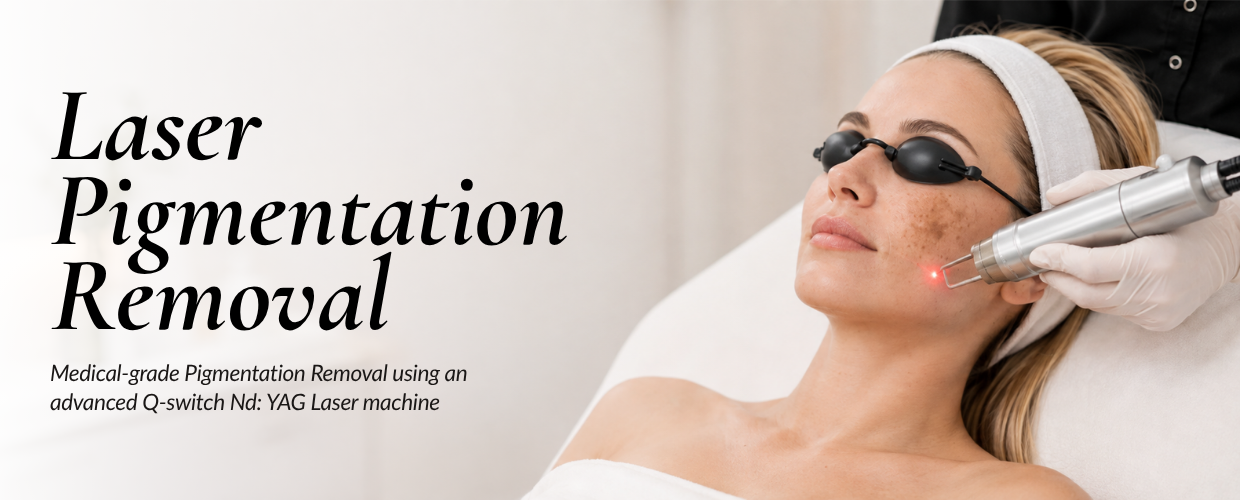
Laser treatments have become a popular choice for those dealing with pigmentation problems, including freckles, melasma, sunspots, and post-inflammatory hyperpigmentation (PIH).
Types of Pigmentation
- Melasma: Melasma is a form of hyperpigmentation in which certain areas of the skin become darker than the surrounding skin. It results from an overproduction of melanin, the pigment that gives skin its colour. Melasma usually appears as irregularly shaped brown or greyish-brown patches, most often on the face, especially the cheeks, forehead, nose, chin, and above the upper lip.
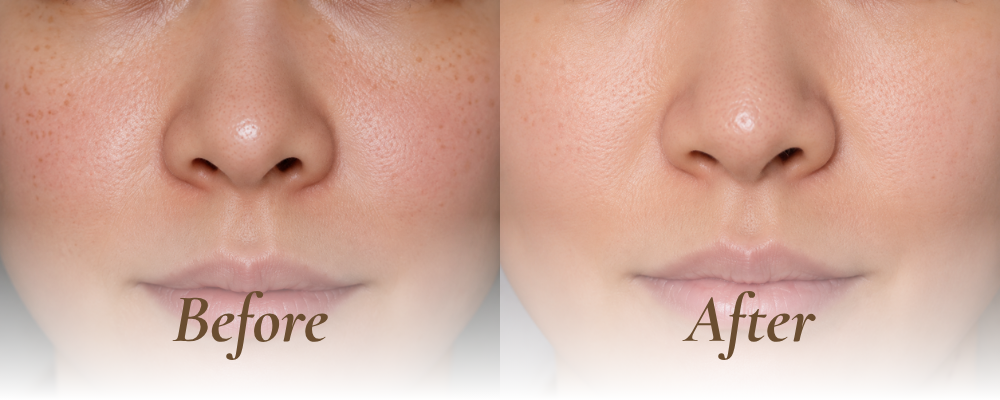
- Freckles: These are the tiny brown spots that form as a result of a genetic predisposition to overproduce melanin in response to ultraviolet (UV) radiation. Freckles are commonly seen in fair-skinned people.
- Sunspots: also known as age spots, sunspots are linked to excessive sun exposure over prolonged periods. The light- to dark-brown-coloured spots appearing on the skin are caused by photodamage. Over time, UV rays accelerate melanin production, resulting in sunspots.
- Post-Inflammatory Hyperpigmentation (PIH): appears as flat spots of discolouration on the skin and is usually caused by injury or inflammation. These patches can range in colour from pink to red, brown or black. Common causes of PIH include acne, eczematous dermatoses, trauma, surgery and burn injuries.
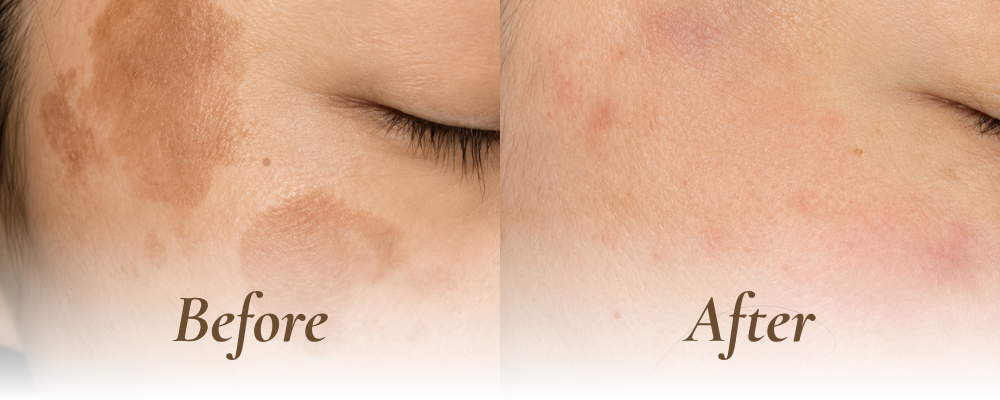
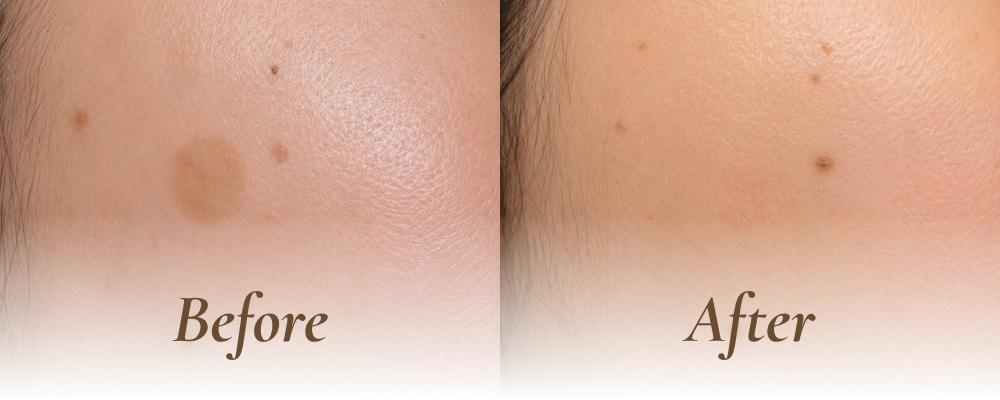
How does Q-switched laser treatment work to remove pigmentation?
Lasers work by passing through the outer skin layer and reaching the deeper layers to target excess melanin pigment. They use light and heat energy to break melanin into smaller pieces. These pieces can then be removed by the body’s natural lymphatic system. The heat also increases collagen production and helps refresh skin tissues. Lasers work at different wavelengths or frequencies, each able to target a specific colour and layer (or depth) of the skin.
The Q-Switched Laser is a Nd:YAG laser operating at 532 nm and 1064 nm in nanosecond pulses. It is a non-invasive device that emits high-intensity light pulses lasting just a billionth of a second. These ultra-short laser pulses target melanosomes within dermal melanocytes, causing them to quickly expand and fracture into tiny particles.
Laser pigmentation removal at Beauty by Joulexa
Beauty by Joulexa offers advanced pigmentation removal using the IRIS by Bluecore, a leading South Korean laser device. This medical-grade Q-switched Nd:YAG laser uses dual wavelengths (1064 nm and 532 nm) to precisely target various types of pigmentation across different skin tones. Its technology delivers ultra-short pulses that break down pigment, which the body then naturally eliminates.
Real-time energy monitoring and smart settings enable customised treatments tailored to each client’s skin type and concerns, ensuring optimal results with minimal discomfort and downtime. The advanced cooling system enhances safety and comfort. Most clients see visible improvement after a few sessions, making the IRIS a safe and effective choice for clearer, more even-toned skin.
Our laser treatment is effective for melasma, freckles, age spots, and post-inflammatory hyperpigmentation.
| Treatment Area | Single Session | 3 Session Pre-Paid Package 20% OFF |
6 Session Pre-Paid Package 25% OFF |
|---|---|---|---|
| Full Face | $315 | $756.00 | $1,417.50 |
| Small Area (Single Blemish) | $95 | $228.00 | $427.50 |
| Nose or Chin | $110 | $264.00 | $495.00 |
| Cheeks | $185 | $444.00 | $832.50 |
| Forehead | $185 | $444.00 | $832.50 |
| Neck & Decolletage | $315 | $756.00 | $1,417.50 |
| Back of Hands | $150 | $360.00 | $675.00 |
| Half Arm (Price per Arm) | $299 | $717.60 | $1,345.50 |
| Half Leg (Price per Leg) | $350 | $840.00 | $1,575.00 |
| Upper Back & Shoulders | $350 | $840.00 | $1,575.00 |
Frequently Asked Questions
Laser treatments use focused light energy to target and break down excess melanin. They offer faster and more precise results than other treatments such as topical creams or chemical peels.
Typically, 2 to 4 sessions are required, spaced 4 to 6 weeks apart. The exact number of treatments depends on the severity of pigmentation. Pigmentation fading after laser treatment typically becomes visible within 1-2 weeks. Initially, the pigmented areas may appear darker before they start to lighten, indicating that the pigmentation is breaking down and being naturally eliminated by the body.
During a laser pigmentation treatment, you may feel warmth or brief, light taps on the skin. The length of the procedure depends on the area treated and usually takes a few minutes to an hour. Protective glasses are worn to shield the eyes from the laser light. After treatment, the skin may look red or puffy. These effects usually resolve within a few hours to a few days.
The permanence of laser pigmentation removal depends on the cause. Post-inflammatory hyperpigmentation (PIH) may be permanently resolved if the trigger does not recur. Sun-induced pigmentation needs ongoing sun protection and consistent skincare to prevent it from returning. Melasma, a chronic condition, often improves significantly but may not be fully curable.
Laser treatments are generally safe for light to medium skin tones. For darker skin tones, additional precautions may be required to minimise the risk of discolouration.